

HITT-Q provides specific indicators of the vulnerability and resilience of the family system and the individual, as well as of historical emotional trauma. The “Landscape-Boat-Person” model helps integrate the HITT-Q results with the individual’s historical context, family history, and current life circumstances
When we work with HITT-Q, we see the numbers: whether a family or an individual has high or low vulnerability/resilience, and whether there is a history of moral trauma
But in the therapeutic process, numbers don’t explain what trauma looks like or where it comes from. There was a lack of a metaphor that would allow us to see where the problem lies: in the historical context, in the family system, within the person themselves, or at the intersection of these levels.
“A person has transgenerational trauma”—it sounds like a label on a box. But a person isn’t a box. She lives in real time, in the here and now, where today there are bombs, tomorrow there’s no electricity, and the day after tomorrow she’s trying to be a mother to her child. She is both a product of her family’s history and a person who chooses how to tell her father’s story to her son.
It’s like pointing to a small town on a map while forgetting about the surrounding mountains, the flowing river, and the people who walk through that town every day.
That is how the “Landscape-Boat-Person” metaphor came about.
Landscape refers to the historical and contemporary circumstances that a person did not choose and cannot undo by their own will. Boat is the family: its structure, damage, resources, the way it stays afloat, and whether it speaks of danger or keeps silent about it. The Person is the one in this boat, who has inherited certain ways of weathering the waves but can learn to row and change the way they describe what they see around them.
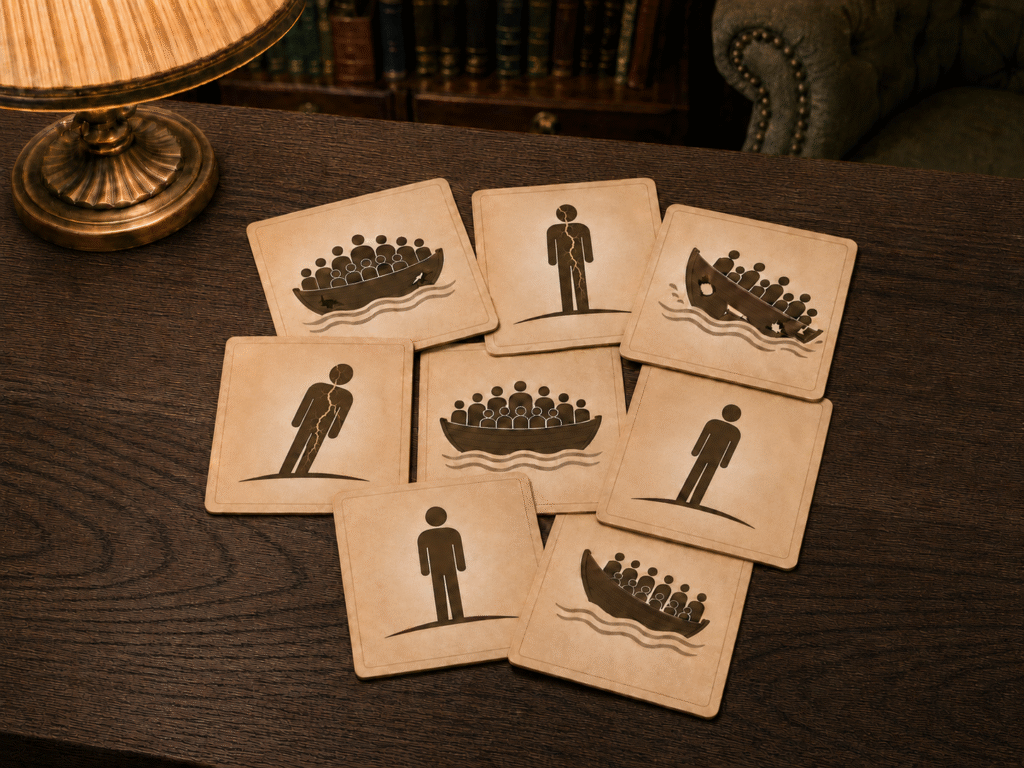
8 visual cues: 4 images of a “Boat” represent possible combinations of family vulnerability and resilience, while 4 images of a “Person” represent possible combinations of individual vulnerability and resilience. The 16 prototypical configurations are intended for clinical formulation and are not diagnostic or statistically established categories.
How to Interpret HITT-Q Results
«Landscape»
The landscape encompasses the historical, cultural, social, and current conditions in which a family lives. It includes events and circumstances that may have affected several generations.
These may include:
- The Holodomor, political repression, the dispossession of the kulaks, and deportations;
- World War II and the Holocaust in Ukrainian territories;
- the Chernobyl disaster;
- the ATO and the full-scale Russian-Ukrainian war;
- forced displacement, discrimination, and the loss of loved ones, homes, language, culture, or social status.
A separate “Landscape” score is not calculated. What matters is how closely the events affected families, what losses they caused, and how their impact is felt today.
«Boat»
The boat represents a family system in which the experiences of previous generations are preserved, processed, suppressed, or passed on. Its state is reflected in family communication, upbringing, relationships, and ways of responding to danger.
The boat is described by two dimensions:
- the vulnerability of the family system;
- the resilience of the family system.
Vulnerability encompasses trauma-related patterns of communication and upbringing, fear, and family distress. Resilience reflects support, emotional safety, the preservation of bonds, and the ability to pass on experiences of survival and recovery to future generations. Traumatic patterns and evident resources can coexist within the same family.
«Person»
A person embodies a descendant who lives in a specific Landscape and is part of a family Boat. At the same time, each person has their own life story, current life circumstances, ways of adapting, and the ability to make choices.
A person is described by two coordinates:
- the descendant’s vulnerability;
- the descendant’s resilience.
Vulnerability encompasses avoidance, heightened responsibility, and traumatic distress. Resilience is linked to the ability to cope, a sense of belonging, and values. The combination of these coordinates shows where a person needs support and what resources they can already rely on. Distress and the ability to act can coexist.
Historical Moral Injury
Historical moral trauma is a distinct cross-cutting indicator of the HITT-Q. It helps us see how historical injustice and a family’s interpretation of it can be linked to a person’s moral experiences today.
It may include:
- feelings of injustice or betrayal;
- shame and guilt; a loss of trust; a moral obligation to the deceased or previous generations;
- a need for recognition and the restoration of justice.
Its significance is considered throughout the model: historical events belong to the Landscape, can be passed on or suppressed in the Boat, and are experienced by the Person.
The landscape influences the Boat and the Person, but does not mechanically determine them. A family can change the ways in which experience is passed down, and a person can reinterpret family history, create different relationships, and shape their own path in life
How to Work with a Model: 6 Steps
1. Start with “Landscape”
Find out which events the person marked, who they affected, what losses they caused, and how their impact is felt today. A separate score for “Landscape” is not calculated. A large number of identified events does not automatically mean a “more severe” experience. What matters is the event’s proximity to the family, the losses incurred, the duration of the impact, the family’s processing of the event, and current reactivation.
2. Read “The Boat”
Compare family vulnerability with family resilience. High scores on both axes indicate that the family may simultaneously harbor traumatic patterns and significant resources. Low vulnerability combined with low resilience may indicate few overt traumatic manifestations coupled with limited access to family support.
3. Read “The Individual”
Compare the individual’s vulnerability with their resilience. A person may experience distress while still remaining capable of acting, supporting others, and drawing on their values. High functionality does not, however, prove the absence of exhaustion or avoidance.
4. Compare the family and individual levels
Analyze how the family’s burden relates to the descendant’s vulnerability. To what extent have family resources become available to the individual? The family’s vulnerability and the descendant’s resilience draw attention to personal resources developed in the context of family vulnerability. Family resilience and the offspring’s vulnerability help identify individual stress that persists despite family support.
5. Consider historical moral trauma
The same combination of the four coordinates can have different meanings depending on experiences of historical injustice, shame, guilt, betrayal, or moral obligation.
6. Clarify the meaning together with the person
The quantitative result suggests topics for further questions but does not provide a complete story about the person and their family. The person has the right to confirm the proposed explanation, clarify it, offer a different interpretation, or reject a particular interpretation.
The basis for interpretation remains the individual configuration of the four coordinates within a specific Landscape. The HITT-Q results serve as a roadmap for exploration, not a verdict on the past.
An interpretive model developed by Tetiana Stanislavska.
Copyright registration certificates: No. 148014 and No. 148015
Select a survey based on your goal: a basic survey with automatic scoring or participation in a research study
Please note
The questionnaire currently available on this page is the Ukrainian adaptation of the HITT-Q, developed and validated specifically for people with experience of Ukrainian collective traumas — the Holodomor, Soviet occupation, and the ongoing war. If you are not from this cultural context, the results may not be meaningful or accurate for your experience.
However, if you have Ukrainian-speaking friends or family members who might benefit from this tool — feel free to share this link with them.
We are actively working on adaptations for other cultural and linguistic contexts. If you are a researcher interested in collaboration, or if you would like to be notified when a version relevant to your background becomes available — please contact us at.
Thank you for your interest in this work.

An automated report with results and explanations based on the Landscape–Boat–Person (LBP) model is available only in the basic version of the HITT-Q. If you are taking a different version of the survey, a copy of your responses will be sent to the email address you provided. You can share this with your psychologist or psychotherapist to help interpret the results.