
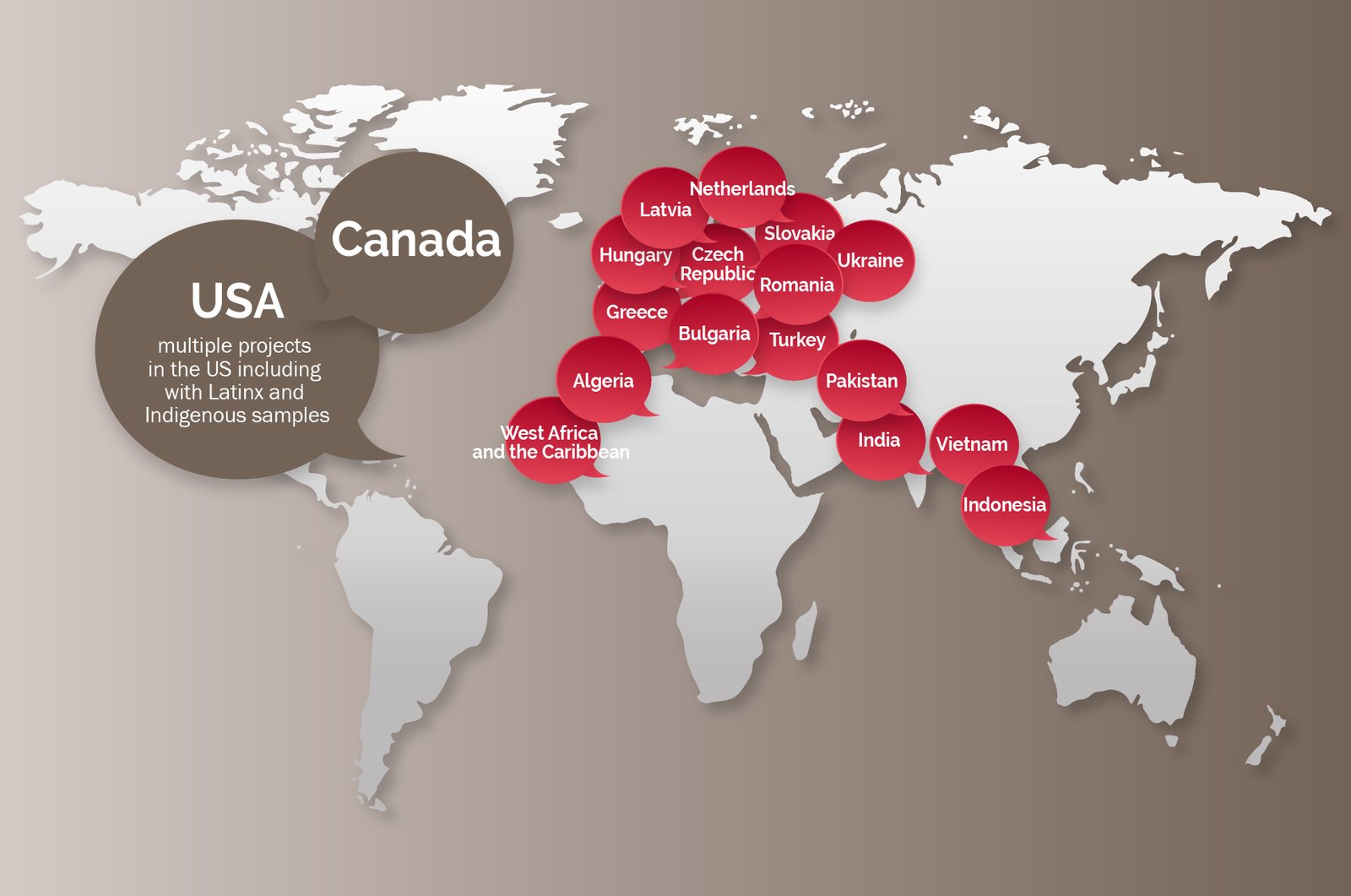
HITT-Q was developed based on research into the descendants of Holocaust survivors. However, historical trauma is not limited to a single people or a single event. Wars, genocides, colonial violence, deportations, political repression, slavery, and forced displacement leave various marks on family histories. Therefore, the HITT-Q is validated and adapted across different cultural contexts
The United States and Canada are the countries where the methodology was developed by its authors—Dr. Vera Bekesh (Ferkauff School of Psychology, Yeshiva University, New York, USA) and Dr. Claire Starrs (Department of Psychology, University of Quebec in Montreal, Canada).
HITT-Q is spreading around the world through local adaptations in countries with their own traumatic histories
Ukraine
Ukrainian adaptation: In 2025, the HITT-Q was translated, culturally adapted, and psychometrically validated in a sample of 299 adult participants. A retest was conducted on 142 individuals.
Study conducted: In 2026, the HITT-Q was administered to two independent samples: 403 civilian participants and 123 service members and veterans, including 93 active-duty service members and 30 veterans. The study examined the associations between transgenerational experiences and current psychological resilience, stress coping strategies, and negative psychological reactions and states.
Hungary
Study conducted: 599 second-generation and 311 third-generation descendants of Holocaust survivors were surveyed. Pronounced trauma-induced parenting styles were associated with greater adjustment difficulties and a higher number of psychological symptoms among the descendants. The results became one of the empirical foundations of the HITT model.
Indonesia
Study conducted: In 2025, an adapted version of the HITT-Q was administered in Indonesia to a sample of 103 young adults. The researchers examined the association between transgenerational trauma and psychological well-being, as well as the role of family functioning in this association.
Bulgaria
The legacy of the totalitarian period in Bulgaria is still felt in the social fabric—particularly in some of the lowest levels of trust in institutions and among individuals in Europe.
Research question: How is the legacy of historical trauma linked to the erosion of social and institutional capital in contemporary Bulgarian society? Is it possible to empirically trace a connection between family experiences of repression and today’s patterns of distrust?
Romania
The decades of the Ceaușescu regime, the Securitate’s pervasive surveillance, and mass repression have left their mark on several generations of Romanian families.
Research question: How is the legacy of the communist period transmitted to subsequent generations? What mechanisms of silence, forgetting, and resentment—specific to the post-communist space—shape the clinical picture among descendants?
West Africa and the Caribbean
The transatlantic slave trade left a traumatic legacy on both sides of the Atlantic—in continental Africa and among the Caribbean diaspora.
Research question: How do the experiences of ancestors who were victims of the slave trade continue to manifest in their descendants? What cultural, somatic, and symbolic forms does this transmission take in West Africa compared to the Caribbean—and do common structural patterns persist despite the geographical divide?
Vietnam
A single family history often involves multiple layers of colonial and wartime trauma: the French occupation, the Japanese occupation, the famine of 1944–1945, the war, the loss of ancestral land, and postwar migration.
Research question: How is this multi-layered legacy passed down through generations in Vietnamese families; what role do migration and the diaspora context play in its reworking?
Czech Republic, Slovakia
The Holocaust left a deep mark on Czech and Slovak families—both through deportations to Terezín and Auschwitz and through the decades of totalitarian silence that followed.
Research question: What biological (neuroendocrine, epigenetic, and structural brain) and psychological markers of the transgenerational transmission of Holocaust trauma can be identified in the children and grandchildren of survivors—and how are they related to the traumatic experiences of the first generation?
Algeria
French colonialism and the subsequent “Black Decade”—the civil war of the 1990s—have created two successive layers of collective trauma, the effects of which are evident in contemporary Algerian society.
Research question: How are these two layers of trauma transmitted to subsequent generations, and how do they interact in shaping contemporary Algerian identity and mental health?
If you are interested in adapting the HITT-Q for your country, cultural context, or specific population, you can contact the authors of the instrument, Dr. Claire Starrs and Dr. Vera Bekesh, for consultation and to coordinate international research collaboration.
Or contact the author of the Ukrainian adaptation, Tetiana Stanislavska—namaste4people@gmail.com—and she will help facilitate the connection.